
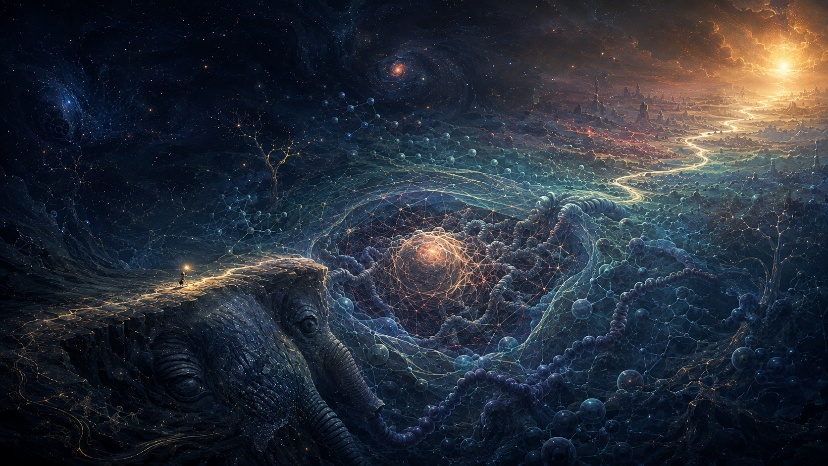
To me, science is a serious game played by children. Awe and curiosity toward nature allow me to remain naïve—even audacious—yet also humble and cautious, submitting every idea to the tests of fact, logic, and experiment. I walk along the edge of a cognitive cliff, venturing as close to the unknown as I can without falling into fantasy. I follow the faint light within me, without hesitation and without fear of looking foolish—because genuine exploration begins where there is no map and no certainty.
I believe that the complexity of life does not necessarily imply that its fundamental rules are equally complex. Behind the bewildering diversity of molecular phenomena, there may lie a small number of simple and universal principles. Random, inefficient, and seemingly chaotic genomic activities may, under physical constraints and continuous selection, give rise to stable biological information and cell fate.
Before the great elephant of life, I am only a tiny ant, unable to see the whole. But I do not want to remain in one place, touching the same small patch over and over and mistaking it for the entire animal. I want to keep moving—to reach farther and explore more widely. While respecting the complexity of biology, I search for its underlying physical simplicity. I hope to move beyond individual molecules and local mechanisms, to perceive the whole through its details, distill principles from phenomena, and test them through experiment, theory, and computation.
Truly good ideas often have a particular quality: before they are clearly articulated, they remain hidden among countless details; once expressed, they seem simple and almost self-evident. What I seek is precisely such a principle—one that suddenly brings a bewildering landscape into focus.
Peter Cook’s imagination, rigor, and reasoning gave me not only scientific courage but also an entirely new way of seeing: science, I discovered, could be done like this. Isaac Asimov’s Foundation, William Gibson’s cyberpunk trilogy, and the Wachowskis’ The Matrix taught me to imagine the future, vast systems, and realities beyond appearances. Laozi and Zhuangzi, Wang Xiaobo, Haruki Murakami, Hermann Hesse, Jean-Jacques Rousseau, and Dante have given me the freedom and courage to examine the world and face myself honestly.
I love life too deeply not to give myself fully to understanding and experiencing it. My scientific journey is a Divine Comedy of my own: passing through Inferno, ascending Purgatorio, and searching for Paradiso. I do not fear the journey, because I believe I will find it.
I love living just as deeply. Running, skiing, strength training, tennis, swimming, and horseback riding allow me to experience the power of the body and the limits of the will. Solitude, reading, and reflection bring me back, again and again, to my inner self. Like Siddhartha, I continue to cultivate three essential capacities: to think, to wait, and to fast.
I will not accept a theory simply because it is widely held or endorsed by authority. I neither conform to consensus nor rebel merely for the sake of rebellion. I am willing to question everything and equally willing to be corrected by evidence. I do science not to prove that I am right, but to move closer to the truth of nature.
I want to become a wanderer of the infinite—moving between the complexity of biology and the simplicity of physics, from microscopic details toward global principles, from observing life to explaining and predicting it, and ultimately, to attempting to build it.